 CLRMarine
ABYC Boat Wiring Color Codes
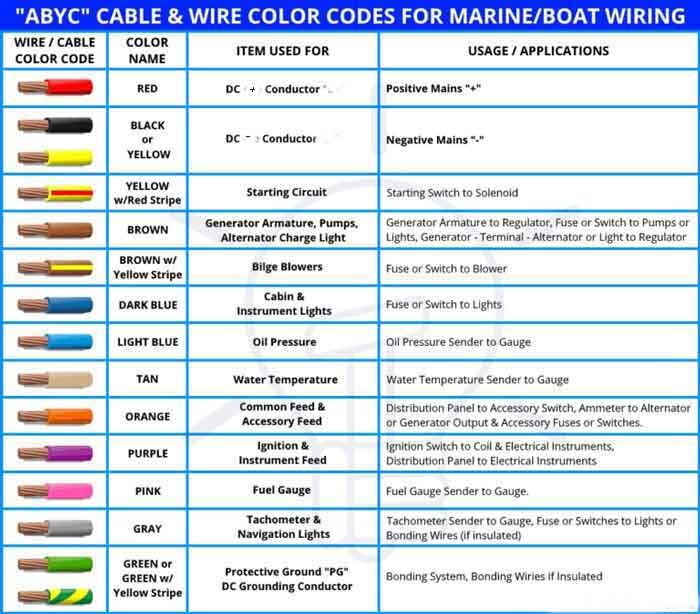
ABYC color codes assign a function to each common marine DC wire color so you can identify a circuit before you cut, splice, or replace it. Use the chart on this page as a reference, then confirm the actual boat wiring and circuit protection before you change anything.
What are the color codes for marine wire?
On boats that follow ABYC practice, colors map to jobs: red is the DC positive feed, black or yellow is the DC negative/return, and other colors mark lights, pumps, ignition, and trim circuits. Read the full table below for each color and typical use.
What color wire is positive on a boat?
Red is the usual ABYC color for DC positive mains (the + / L+ feed). Do not assume every red conductor is unfused battery positive — check the breaker or fuse and the device end before you work on it.
What color is boat ground or negative?
Black or yellow is the usual ABYC color for DC negative / main return. Many boats use yellow specifically to avoid confusing black DC return with AC hot. Follow the color already installed on that vessel unless you are rewiring the circuit to a documented standard.
What is ABYC wire?
People say “ABYC wire” when they mean marine-grade boat cable used with ABYC color and installation practice. Look for marine insulation, stranding, and (when specified) tinned copper. Match gauge, conductor count, and color to the job, then open the matching CLR Marine listing.
How should a boat DC circuit be color-coded?
Keep one function per color on that circuit, protect the positive feed, and land the return on the documented negative. Use the table below for starter, ignition, blower, bilge, nav-light, and trim colors. Shop tinned marine wire and terminals on this site after you know gauge and color.
Marine wire · Terminals · Ancor · Search by gauge, color, SKU, or MPN
|
|
On this Item |
That Use |
| Black |
Ground |
Negative / Neutral Main Return |
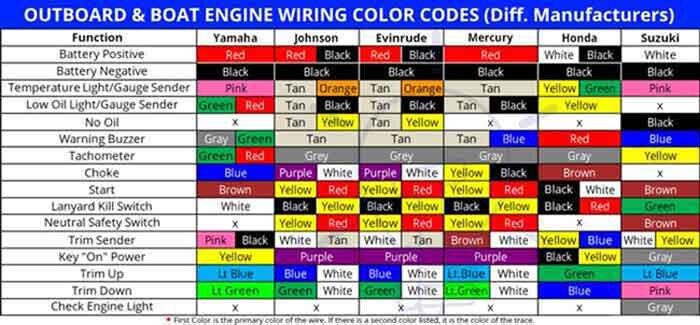
| Blue-Stripe | Tilt up and or trim out | Tilt and or trim circuits |
|
Brown |
Alternator Charge Light |
Generator Terminal or Alternator Auxiliary Terminal to Regulator |
|
|
Generator Armature |
Generator Armature to Regulator |
|
|
|
Circuit Breaker or Switch to Pumps |
|
Brown w/Yellow |
Bilge Blowers |
Circuit Breaker or Switch to Blower |
|
Dark Blue |
Cabin & Instrument |
Circuit Breaker or Switch to Lights |
|
Green or |
Bonding System |
Grounding Wires (if insulated) |
|
Green w/Yellow Stripe |
|
|
| Green Stripe | Tilt down and/or trim tab | Tilt and or trim circuits |
|
Grey |
|
Circuit Breaker or Switch to Lights |
|
|
|
Tachometer Sender to Gauge |
|
Lt. Blue |
|
Oil Pressure Sender to Gauge |
|
Orange |
Accessory Feed |
Ammeter to Alternator or Generator |
|
|
Common Feed |
Distribution Panel to Accessory Switch |
|
|
Feed |
Accessory Circuit Breakers or Switches |
|
Pink |
|
Fuel Gauge Sender to Gauge |
|
Purple |
Ignition |
Ignition Switch to Coil & Electrical Instrument |
|
Red |
Power Feeds |
Positive Main Power (particularly un-fused) |
|
|
Instrument Feed |
Distribution Panel Electrical Instruments |
| Tan | Water temperature | Water temperature sender to gauge |
|
Yellow |
Generator Field |
Generator to Regulator Field Terminal |
|
Yellow |
Ground |
Negative / Neutral Main Return |
|
Yellow w/Red |
Starting Circuit |
Starting Switch to Solenoid |
CLR Marine recommends using marine type wire from Ancor Wire, as the wire is tinned to help eliminate corrosion. Don't forget to use the proper Wire Connectors and Wire Terminals. Now that you have your wire ready don't forget about Wire Management. Do you need Wire Tools, such as Crimpers how about Heat Shrink Tubing which can also be found in Wire Management.
Wire / Conductor Sizes
Length (feet): Determined by measuring the length of the wire from the positive (+) power source connection to the electrical device and back to the negative (-) power source connection. Note that the power source connection may be the battery, panel-board or switchboard.
Current (amps): Determined by adding the total amps on a circuit.
Wire sizes not covered in Table C or Table D may be calculated by using the following formula:
After calculating the Circular Mil Area (CM), use Table B to determine the proper conductor size. The National Fire Protection Agency and Coast Guard require that the next larger conductor be used when the calculated CM area falls between two conductor sizes.
CM=K x l x L / E
CM = Circular Mil area of Conductors
K = 10.75 (Constant representing the mil-foot resistance of copper)
I = Current - amps
L = Length - feet
E = Voltage drop at load (in volts)
For Example:
Q. A bilge pump draws 10 amps. The positive run is 11 feet from the power panel, including the float switch. The negative run is only 10 feet. What size wire?
A. Use the following formula to reach the correct answer:
CM = 10.75 x 10 (amps) x 21 (total length of run) / 0.36 (3% of 12v) = 6,271
The table below shows that 12 AWG wire has a CM area of 6,500 and is the correct choice. However, SAE wire has a CM area of only 5,833. Under NFPA and USCG regulations, 10 SAE wire must be used.
CM = 10.75 x 10 (amps) x 21 (total length of run) / 0.96 (3% of 32v) = 2,352
Ampacity is the ultimate safe current carrying capacity of the wire before damage occurs to the insulation, without regard to voltage drop. Because the insulation of most SAE wire types is not the same as ANCOR, this chart should not be used for other conductor types.
| AWG | Sq. mm |
AWG CM area |
SAE CM Area |
Ampacity |
Ampacity |
| 18 | 0.8 | 1,600 | 1,537 | 20 | 17 |
| 16 | 1 | 2,600 | 2,336 | 25 | 21 |
| 14 | 2 | 4,100 | 3,702 | 35 | 30 |
| 12 | 3 | 6,500 | 5,833 | 45 | 38 |
| 10 | 5 | 10,500 | 9,343 | 60 | 51 |
| 8 | 8 | 16,800 | 14,810 | 80 | 68 |
| 6 | 13 | 26,600 | 24,538 | 45 | 38 |
| 4 | 19 | 42,000 | 37,360 | 160 | 130 |
| 2 | 32 | 66,500 | 62,450 | 210 | 178 |
| 1 | 40 | 83,600 | 77,790 | 245 | 208 |
| 1/0 | 50 | 105,600 | 98,980 | 285 | 242 |
| 2/0 | 62 | 133,100 | 125,100 | 330 | 280 |
| 3/0 | 81 | 167,800 | 158,600 | 385 | 327 |
| 4/0 | 103 | 211,600 | 205,500 | 445 | 378 |

CLR Marine is proud to serve the boating community by providing top-quality marine supplies for safety, performance, and adventure on the water.
MORE SITE LINKS
Rebate Corner
Government
Veterans Corner
Links You May Like
Contact Manufacturer
Rebate Corner
On-line Magazines
Of Interest to boasters
Video
Sitemap
FAQ
Store Policy
Troubleshooting

PRODUCT CATEGORIES
CLR Marine is proud to serve the boating community by providing top-quality marine supplies for safety, performance, and adventure on the water.
MORE SITE LINKS
