Bilge Pump Troubleshooting: Why Your Pump Isn’t Working & How to Fix It
The Most Common Reasons a Bilge Pump Won’t Turn On
1. Electrical Problems (Responsible for up to 80% of failures)
Marine technicians consistently report that most bilge pump failures stem from electrical issues—corroded wires, blown fuses, weak batteries, or bad connections.
What to check:
- Corroded or loose wiring
- Blown fuse or tripped breaker
- Low battery voltage
- Bad ground connection
Quick Fix:
Clean connections, replace the fuse, and test voltage at the pump.
2. Float Switch Failure (Most common cause of “pump won’t turn on”)
Float switches often get stuck due to debris, corrosion, or mechanical wear. Many sources note that up to 90% of “won’t turn on” issues trace back to a faulty float switch.
What to check:
- Debris under the float
- Sticking hinge
- Failed internal switch
Quick Fix:
Lift the float manually. If the pump activates, replace the switch.
3. Clogged Intake or Blocked Strainer
If the pump hums but doesn’t move water, the intake may be blocked by sludge, hair, or debris.
Quick Fix:
Clear the strainer and flush the bilge area.
4. Burnt‑Out Motor or Jammed Impeller
A pump that runs but won’t pump—or doesn’t run at all—may have a seized impeller or failed motor.
Quick Fix:
Inspect the impeller for debris. If the motor is burnt, replacement is the only solution.
5. Pump Runs Continuously (But Doesn’t Remove Water)
A continuously running pump signals a leak, float switch failure, or internal pump malfunction.
Quick Fix:
Check for leaks, test the float switch, and inspect the discharge hose for blockages.
Step‑by‑Step Bilge Pump Troubleshooting Checklist
1. Test the Manual Switch
If the pump runs manually but not automatically, the float switch is the culprit.
2. Check Voltage at the Pump
Use a multimeter to confirm power is reaching the unit.
3. Inspect the Fuse & Wiring
Replace corroded connectors and ensure marine‑grade wiring is used.
4. Clear the Intake & Strainer
Remove debris and ensure the pump is mounted correctly.
5. Test the Discharge Hose
Look for kinks, clogs, or backflow issues.
6. Evaluate Pump Age
If your pump is more than 3–5 years old, replacement may be more cost‑effective than repair.
When to Replace Your Bilge Pump Instead of Repairing It
Replace your pump if:
- The motor is burnt out
- The pump fails repeatedly after electrical fixes
- The float switch and wiring are new but the pump still won’t activate
- The pump is undersized for your vessel
Browse reliable replacements here: CLR Marine Bilge Pumps
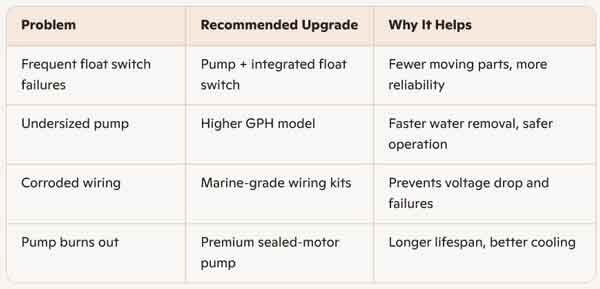
Recommended Bilge Pump Upgrades (Based on Common Failure Points)
FAQs
Why does my bilge pump run but no water comes out?
Likely a clogged intake, blocked discharge hose, or jammed impeller.
Why won’t my bilge pump turn on at all?
Electrical issues or a failed float switch are the most common causes.
How often should I test my bilge pump?
Marine experts recommend testing before every outing and monthly during storage.
Final Call to Action
A failing bilge pump is more than an inconvenience—it’s a safety risk. Now that you understand the most common causes and fixes, you can confidently diagnose the issue and take action.
If your pump is beyond repair or you want a more reliable upgrade, explore CLR Marine’s curated selection:
 CLRMarine

